You handed off some work, and it’s off your plate, but….it’s not going great. Uh oh. Was this a hiring mistake? Motivation problem? Do I intervene? What do I say?? Maybe I should just do it myself…
Wait! Before you take it back and add it to your long long list, check these things to diagnose where the problem is, so you know the easiest way to intervene.
Note: I’m actively developing this framework. If you read this and apply it to your examples, I would LOVE to hear about it, both if it works and if it didn’t quite fit. I want lots of examples so please do reach out!
What to check (and in what order)
Order matters! Check and fix each one before moving on to the next.
- Expectations. Are desired outcomes and any constraints clear enough to you that you can write them down? Did they understand the desired outcomes accurately? Do they understand how you see the priority relative to their other work, or did they think it was a nice-to-have? (Note: this is simple, but not easy! It can be so hard to put your expectations into words that this will be the focus of the next piece in this series)
- Authority & Resources. Do they have the access to the files, information, budget, and face time they need to complete the work? Do they have the authority to get key people to help them, or do they need to borrow your authority? Are you aligned on the level of delegation for this task? Do they have the time and space to work on this, or are they buried?
- Incentives & Stakes. You can't force someone to feel motivation, but you can make sure your shoelaces aren't tied together.
- Stakes: By virtue of your altitude, the big picture is often blindingly obvious to you. But if you have not yet developed the habit of talking about it constantly, others may be thinking on the day to day level. Do they understand the context and the impact of the work, and how it connects to the bigger goals of the company? Do they see dominos it will let us knock down, and how it will change the culture or product? Ideally these should be framed in terms that they care about, if you know what they value.
- Incentives: How does it hurt or help their career progress? If it would help them, have they connected those dots yet? If they are good at this task, will they be saddled with more work they don’t want? Will this make a lot of people mad at them?
- Skills. Do they know how to do the thing? If not, how fast can it be learned? Is there a glaring fit problem between the person and the kind of work?
- Crisis. Are there extenuating circumstances? These are usually personal (health issues, caretaking, etc)
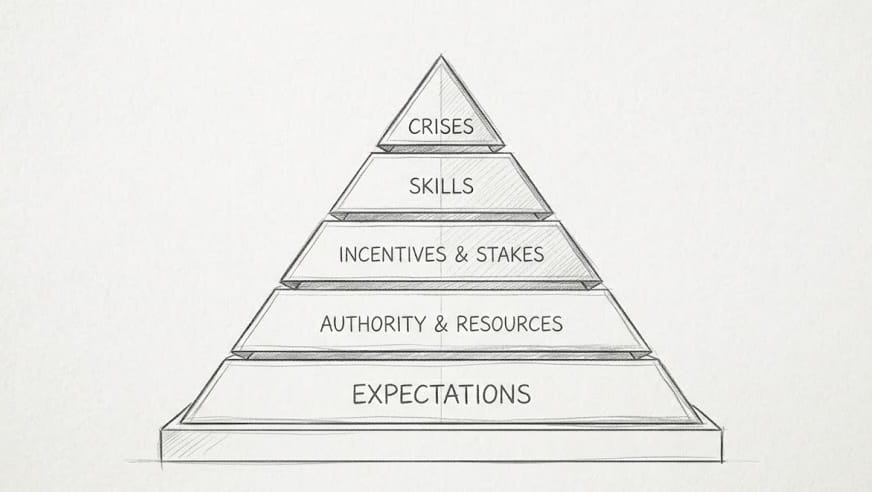
Why this order?
This order saves you time, angst, and wandering around wondering what to do.
Levels build on each other
Working on higher levels is a waste of time if lower levels are shaky.
Skills don’t matter if they don’t understand your Expectations, because they’ll use their skills to build the wrong thing.
Incentives don't matter if they don’t have the Authority to complete the task, because no matter how much they want to get it done, they’re blocked.
So check the foundation first.
Try easy fixes first
The foundations are also the quickest to fix, so it makes sense to start there.
You can fix Expectations and Authority with a conversation. Motivation & Stakes is also a conversation, though one you may have to thoughtfully prepare for. Skills generally take some time and/or money to change. And there’s just not much you can do about a Crisis.
Keep it simple. Only try the harder interventions if you actually need them.
Next in the series
This is the second post in a series about getting work off your plate—for good!—with less angst.
- Too many employee questions? Your helpful answers may be why
- What to check when delegation isn't working (👈 you are here)
- Next up: we unpack Step 1: Expectations! It’s the most foundational, useful, and subtle step, and deserves a deep dive.
Want more tips on other steps? Let me know so I add them to my roadmap.